5 Facts About True HEPA Filtration for Healthcare Construction
Watch out for Imposters: 5 Facts About True HEPA Filtration for Healthcare Construction
Did you know that, annually, over 2 million patients in the USA suffer healthcare-associated infections from airborne pathogens? Meanwhile, just across the border in Canada, one in every nine hospital patients contracts a healthcare-associated infection from pathogens. Not all Hepa Filters are created equal, and it can be challenging to find a trustworthy vendor. Abatement Technologies prides themselves on developing products that lead the way in design, performance quality, reliability, but most importantly products that safeguard peoples health.
When healthcare facilities are undertaking renovation and construction projects, it is critical that contractors understand what true HEPA filtration means and follow the regulations that ensure patient health and safety. When selecting a construction air handling unit, the information from vendors about high-efficiency particulate air (HEPA) filters can feel overwhelming. Your questions may include:
What does HEPA stand for?
How is HEPA used?
What is HEPA?
Instead of taking a deep-dive through the ‘HEPA Wikipedia page,’ sit back, relax, and let Abatement Technologies, a leader in the design and manufacturing of powerful abatement products, share with you our insights about true HEPA filtration.
HEPA Filtration in Healthcare Construction
What is HEPA Filtration?
HEPA is an acronym for "High Efficiency Particulate Air'' or sometimes known as "High Efficiency Particulate Arrestance." This acronym refers to a filter that is manufactured, tested, certified, and labeled in accordance with current HEPA filter standards. There are several subclasses within the HEPA classification. Unlike electrostatically-charged air filters and other technologies that experience loss of efficiency as they become dirty, the exact opposite happens with HEPA filters. In fact, the dirtier the filter gets, the more efficient it becomes
How Efficient is HEPA Filtration?
HEPA filtration is highly efficient due its ultra-fine, glass-fiber medium that captures microscopic particles that can easily pass through other filters by a combination of diffusion, interception and inertial impaction. To meet the minimum requirements of a HEPA filter, the filter must be tested and certified to prove that it will remove at least 99.97% (9,997 out of 10,000) of particles 0.3-micron in diameter from the air passing through the filter. Particles that size are about 300 times smaller than the diameter of a human hair, and 25 to 50 times smaller than we can see. To a HEPA filter, catching a one-micron particle (1/1,000,000 of a meter) is the equivalent of stopping a cotton ball with a door screen.
What are the Certification Requirements?
The recommended practices for HEPA filter construction, performance, labeling and certification are maintained by the Institute of Environmental Sciences and Technology (IEST) and Underwriters Laboratories (UL). Some of the primary requirements include:
IEST-RP-CC021 “Testing HEPA and ULPA Media”
IEST-RP-CC001 “HEPA and ULPA Filters”
IEST-RP-CC034 “HEPA and ULPA Filter Leak Tests”
What about Filtration Maintenance?
It is essential to perform periodic testing every 6 to 12 months in addition to whenever the HEPA filter is replaced. This frequency of testing will ensure that the HEPA filtration device continues to provide true HEPA efficiency. Additionally, CDC guidelines recommend periodic testing and it is commonly required by facilities as well. HEPA filters can break down over time, and replacement every two years is recommended, even if the device is not used. The size and concentration of airborne contaminants, temperature, humidity conditions and duration of use determine how often filters need replacement. As all air filters become loaded with particulate matter, the static pressure differential across the filters will increase, and the airflow capacity of the air filtration device will decrease.
Take It Up a Notch for Patient Isolation
Create CDC Compliant Surge Patient Isolation Capacity in Hospitals and Healthcare Facilities
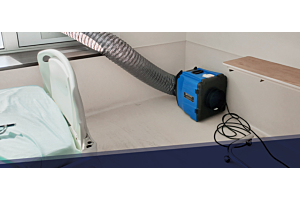
Abatement’s high-efficient HEPA-CARE® In-Room Air Purification Systems have set the gold standard for reliable and economical solutions that help hospitals and other healthcare facilities comply with CDC guidelines for airborne infection control. The HEPA-CARE® Air Purification Systems from Abatement Technologies are equipped with high-efficiency HEPA filters that significantly exceed IEST and UL requirements. These filters are tested and certified to 99.99% HEPA efficiency, which means that they remove at least 99.99% of particles as small 0.3 microns in size. In other words, permissible leakage (1 out of 10,000 particles) is 3 times lower than for a standard HEPA filter (3 out of 10,000 particles). The filters are constructed from microglass media in accordance with the IEST construction requirements and tested and labeled in accordance with IEST safety requirements and UL 900 flammability requirements. As an added user benefit, our MERV-8 pre-filters are treated with EPA registered, broad spectrum antimicrobials designed to inhibit microbial growth and protect the integrity of the filter media.
As a leader in the design and manufacturing of powerful abatement products, Abatement Technologies is dedicated to providing products that reliably remove or help to protect from harmful particulates, bioaerosols and volatile organic compounds to improve indoor air quality.
How do I get started?
Choosing the right filtration system can make all the difference—and we're here to guide you. Connect with one of our solutions experts today to find the best fit for your project.
Share on Facebook
Share on Twitter