Meeting Infection Prevention and Control Standards in Long-Term Care Homes

· Learn how to meet CSA Z8004:22 standards for airborne isolation rooms (AIRs) without major construction.
· Discover modular containment, in-room air purification, and pressure monitoring solutions for LTCH.
The safety of residents in long-term care homes (LTCH) has been examined more carefully in the wake of recent global health challenges than it ever has before.
The release of CSA Z8004:22 (Long-term care home operations and infection prevention and control) from CSA Group places renewed importance on infrastructure requirements to limit the spread of airborne microorganisms in LTCH.
This blog explores the CSA guidelines for infection prevention and control in long-term care homes and how Abatement Technologies® can assist LTCH in obtaining and deploying the necessary equipment to meet them.
What Are the Key CSA Z8004:22 Requirements for LTCH?
· Airborne Isolation Rooms (AIRs): These rooms must be designed, constructed, and ventilated to maintain negative pressure relative to adjacent areas and contain airborne pathogens.
· Anterooms: If an AIR includes an anteroom (a transition space between an uncontrolled area of the building and AIR), the anteroom must also maintain negative pressure relative to the corridor or other adjacent areas.
· HVAC Zones: HVAC systems should ideally align with "households" (a small number of residents who live in the same dedicated area of the building), using airflow to achieve pressure differentials that assist in airborne separation between these zones.
· Verification: Facilities are required to check and verify airflow and pressure relationships to ensure cleanliness and odor control.
Retrofitting HVAC systems and renovating space in existing facilities to meet these standards can be cost-prohibitive or logistically impossible without major construction. Abatement Technologies can provide the critical solutions needed for these spaces without the need for significant and costly renovations.
How Can Abatement Technologies Support CSA Compliance in LTCH?
Abatement Technologies helps prepare long-term care homes for CSA Z8004:22 compliance by offering a full suite of specialized hardware solutions tailored to contain, pressurize, and monitor designated spaces. Critical CSA standards can be achieved entirely without the need for disruptive and costly renovations.
1. CONTAIN: Creating Isolation Zones
The CSA Z8004:22 standard highlights the requirement for separation between households in LTCH. In cases where permanent walls aren't an option, modular, temporary barriers are the answer.
· The Solution: SHIELD WALL™ Modular Containment Systems.
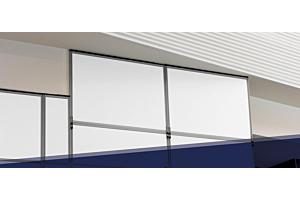
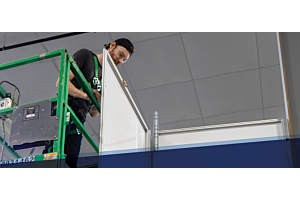
· How it Works: SHIELD WALL™ CORE and CLASSIC panels and doors are quick to deploy, creating a reliable barrier to help prevent contaminants from entering or escaping.
· Application: These barriers can be used to both construct a temporary anteroom outside a resident's door or to section off parts of the facility during an outbreak. The system meets CSA Infection Control standards, making it ideal for high-risk infection control environments. The panels are easy to clean and decontaminate, supporting IPAC protocols.
2. PRESSURIZE: Creating Negative Pressure
To convert a standard resident room into a temporary AIR or manage air quality during renovation, air must be mechanically exhausted to create negative pressure.
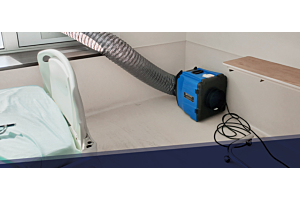
· The Solution: HEPA-CARE® freestanding and ceiling-mounted In-Room Air Purification Systems.
· How it Works: These units pull air from the room, filter it through medical-grade filters (99.995% efficiency against 0.3-micron particles), and exhaust it to create the required negative pressure differential.
· Application: HEPA-CARE® In-Room Air Purification Systems help meet the requirement for reducing airborne contaminants and maintaining pressure differentials in isolation scenarios.
3. MONITOR: Verifying and Maintaining Compliance
CSA Z8004:22 dictates airflow and pressure relationships must be routinely checked and verified.
· The Solution: Differential pressure monitors.
· How it Works: The RPM-RT1/RT2 (Room Pressure Monitor) continuously monitors the pressure of a room relative to a reference area (such as a hallway). The PPM3-S and PPM4 are portable versions with a colour touch screen that send audio, email, or sms alerts if negative pressure is lost.
· Application: Differential pressure monitors allow for reading history onscreen or uploading the data to a PC, helping facilities maintain the documentation required regarding system operating capacity and relative pressurization settings.
Conclusion
Meeting the CSA Z8004:22 guidelines for negative pressure and airborne isolation doesn't always require a complete facility redesign. By utilizing modular containment walls, high-performance air purification, and differential pressure monitors from Abatement Technologies, long-term care homes can effectively manage infection risks, creating safer environments for their most vulnerable residents.
Ensure your LTCH facility is prepared to meet the CSA Z8004:22 guidelines! Explore our full suite of compliant-friendly solutions, or reach out to our team today to build a CSA Z8004:22 compliance plan quickly and cost-effectively.